Goodhart's Law: why I don't talk about grades any more.

I was talking the other day to an excellent and diligent student of mine who was concerned that she wasn't hitting her target grade in English. I asked her what her teacher had advised so far and she told me "I need to work more on my AO3". For those of you not in education, AO stands for Assessment Objective. There are separate objectives for each subject which are the same for every exam board. Exams need to ensure that they are measuring students by each of these standards. In English Literature for example, Assessment Objective Three is: Demonstrate understanding of the significance and influence of the contexts in which literary texts are written and received. In layman's terms this simply means that students are expected to have some understanding of when and where the texts were written, the culture of that time and place, and - crucially - use that information to support and develop their analysis of the text. What happens in reality is that students will read up on a particular historical period (the Jacobin period! the Roaring Twenties! the Industrial Age!), absorb a few key words, phrases, and ideas (The Great Chain of Being! The Dust Bowl! The Patriarchy!) and then scatter them liberally across their essay like garnish.
Adding in these ideas is not a bad thing. You can't understand Steinbeck's Grapes of Wrath without knowing at least a little about the Depression. You can't understand the politics of Macbeth without understanding the Great Chain of Being. However this is merely recognising what was happening in a particular period; in order to achieve this AO you must use this knowledge to dig deeper into the text. But students are getting used to ticking off AOs as jobs to be done, rather than skills that the examiner will identify as they are embedded into the writing.
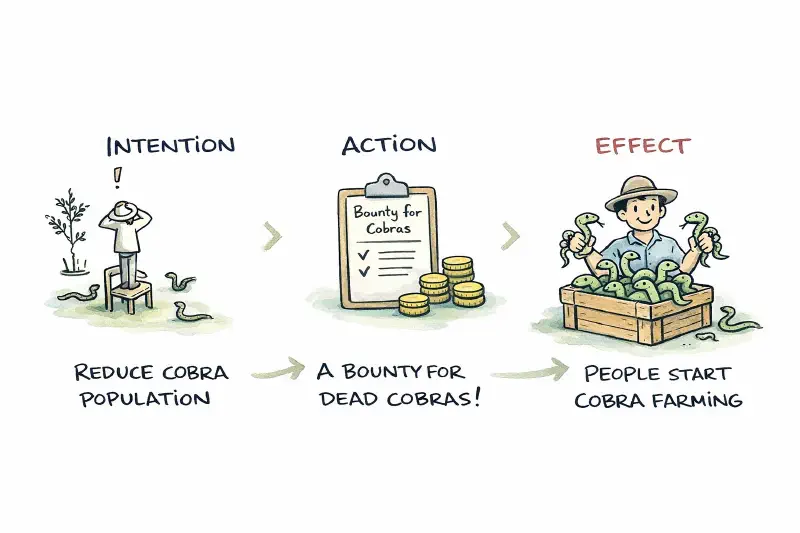
Sometimes, listening to politicians, it can be unclear what they believe education is actually for. We hear lots of talk about "growth", "fulfilment", "being the best you can be". This fluffy vocabulary illustrates a world in which some have forgotten what the original intention of education actually is, or even have developed an entirely new purpose for schooling. For parents, often, the intention is for students to get good grades. This is an entirely laudable aim - I share it - and one which is clearly measurable whether you know much about education or not. It's a reasonable one particularly in subjects like maths where the answer is either correct or it isn't, but when it is applied across a whole cohort unintended consequences start to appear. This issue puts me in mind of Goodhart's Law. Simply put it states this: when a measure becomes a target, it ceases to be an effective measure. There are a number of highly amusing examples of this (the cobras in the cartoon being one of my favourites), but in education it is becoming an increasing problem. Students are beginning to perceive their grades as a target (because we tell them to) and thus find any route they can to it, forgetting on the way what the measure was for in the first place.
We measure success by grades, and thus students inevitably look for the quickest, easiest ways to achieve those grades. This is perfectly reasonable. First they look at those tools that they are most used to: YouTube or TikTok videos by people who may or may not be teachers; apps with knowledge tests; formulaic processes given by teachers as scaffolds. But these things do not teach how to form a coherent argument, or to analyse a text - they teach you how to tick off an element of the mark scheme. This is not the same thing. Thus students can produce an entire essay which fulfils many of the criteria (point! evidence! explain!) but which is a recognisably poor piece of writing. It gets worse when AI comes into the mix: now a student can hand in a piece of writing which adheres to all the rules of grammar and rhetoric but which they have only been superficially involved in producing.
Does this matter? Perhaps for some people it doesn't. Efficiency has its place and AI, apps, and simple tricks and processes make completion of a target quicker and simpler. But if education is about supporting students to develop their own skills and learn about how they have achieved their goals, then a focus on targets and even objectives becomes a distraction. We need to keep reminding students of first principles: what are they there to learn? In English, you are learning how to interpret, understand, and evaluate the writing of other people and then, how to communicate your understanding with clarity and precision. In history, you are learning to identify and evaluate the causes and significance of events in the past, and then, again, how to communicate your understanding with clarity and evidence. Ticking off the assessment objectives may guide students on a path to mastery but they are not the end in themselves.
While schools will inevitably continue to use target grades for their statistics, and assessment objectives for their mark schemes, it is worth reminding students that these things are measures - they are not the end in themselves. The purpose of learning is to achieve competence in your subject and no amount box-ticking - or tik-toking - will get you there.



Comments