Patriarchy, Socialism, and the Application of Context to Literary Analysis.


There is a problem that I notice amongst my most diligent students that has been developing over the past few years, particularly in English Literature. Certain terms crop up in discussion and in essays about particular books, poems, and plays, dropped in without warning or context with a flourish of an unbeatable hand. "Socialism!" is what I'm told when I ask what An Inspector Calls is all about. "Superego!" is apparently the underlying cause of Jekyll's transformation into Hyde. And, of course, when considering the plight of every female protagonist we must nod our heads sagely and invoke the unarguable "patriarchy" as the cause. Of course this is a result of teachers dutifully teaching context as required by Assessment Objective 4 of English Literature. Can you really understand what Priestley was doing with An Inspector Calls if you are not aware of the domestic impact of the Second World War? How can you understand the full horror of regicide without some grasp of the Divine Right of Kings and the Great Chain of Being? And, of course, how can you possibly grasp the horrors and humiliations of female existence before second wave feminism, without acknowledging the patriarchy, looming over the whole of human history like some monstrous fiend.
There is a logic to this and, as a teacher of both literature and history, it is appealing. I love an excuse to cross the streams of the two subjects! It is also helpful for time-starved teachers who need to set homework: learning terminology like this lends itself neatly to multiple-choice quizzes that check understanding and allow retrieval practice. The problem comes when students have to then apply this in a meaningful way to extended analysis of a text, and this results in two main issues.

The first is that frequently, contextual information will be dumped unceremoniously into a discrete paragraph in a similar manner to my son placing his breakfast dishes in the kitchen, but not in the dishwasher. He's got the right idea - the dishes need to be there, but inside the dishwasher, not next to it. I appreciate this is a clumsy analogy but let me stretch it a little further. Why doesn't he put the bowl in the dishwasher? Maybe he can't be bothered, possibly there isn't room, in all likelihood there may be room but he will need to move things around. So it is with using context in literary analysis.
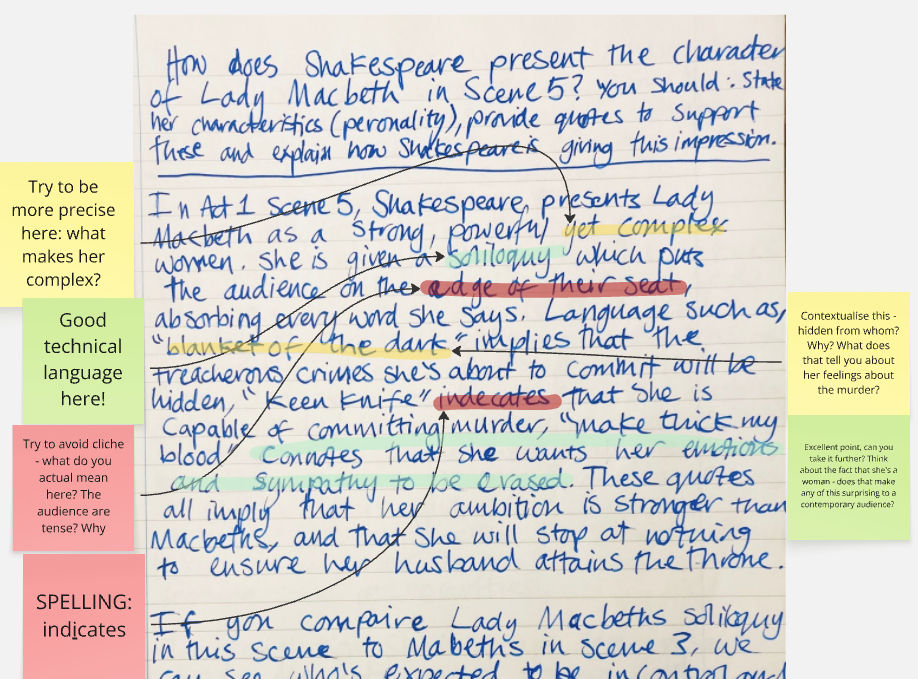
But fitting context in is one thing (I'm going to abandon the dishwasher now), using it meaningfully is something else entirely. Students who do this successfully are rarely hung up on the keywords because they recognise that they work as analysis-terminators. Once you invoke, for example, "the patriarchy" - what more is there to say? You have backed yourself into an analytical corner. If, on the other hand, you use the idea of male and female roles within marriages and the home in nineteenth century Scandanavia, then you can start to comment on the typicality - or otherwise - of Nora in A Doll's House. You can notice where the character conforms and where she rebels. You can judge the extent to which breaking out of social norms is possible for a woman like her in that sort of environment. And from here you can look to the language, the form, the structure which Ibsen uses to create these impressions. Or (even better I think) start with the language and work outwards until you run up against context.
For teachers I would say this: leave terminology like patriarchy and socialism alone. Talk about their meanings and the sorts of historical events that may have impacted the ideas and perspectives of the writers. Talk about how life is different in Jacobean times compared to the twenty-first century. Talk about what we in modern times might find shocking or strange and what is universally true. But - crucially - do not talk about these things in isolation: make sure that students are constantly making the link between the words and the context and what they are telling us. And if you absolutely must invoke modern political terminology, make sure you allow students to consider multiple interpretations of their meanings. Feminism has at least three waves and a million subsets - if you're going to call something or someone feminist, define your terms!

For students, I challenge you to write your context-heavy essays without any resort to keywords. I don't want to know that Steinbeck was a socialist (particularly since he wasn't - he was a New-Dealer if anything and the term "socialist" was thrown at him as a slur) but I do want to know what he has seen to write such a bleak conclusion to Of Mice and Men. I don't want to hear that Christina Rossetti was a High Church Anglican - particularly if you don't really know what that means - I want to know how her faith comes out in her poems; what she is struggling with; how her belief helps and frustrates her. I want to know if you think your books reflect typical attitudes of the society from which they came or if they became famous because they were so outrageous to contemporary ideas. I want to know if there are reflections of the writers' own experiences in the texts and if so, are they universal or very personal? I want to know, above all else, what YOU think about the words you are reading and the ideas that they represent. I want to know if they seem agreeably familiar or weirdly distant.
Anyway, for those of a TL;DR disposition, my point is this:
context needs to be applied rather than simply acknowledged.
avoid using political terminology and instead describe it so that you know you are talking with accuracy.
context should never be stand-alone: always link it to a quote, a character, a moment, or a theme.
For A Level Students:
Always read the introductory essay at the start of your text!
Take a look at a timeline or overview of the period in which the text was written.
Try to read a few other texts from the same period or on a similar topic.
I'd love to hear from students who are struggling with applying context and am considering running some seminars on Saturday mornings to help build contextual understanding of texts. If this is something you might be interested in, drop me an email and let me know which texts you need the most help with.

Comments